At least once over false exactly once
A stable webhook ID gives receivers an idempotency key while lease recovery accepts that duplicate network delivery can occur.
Distributed systems · Webhook delivery
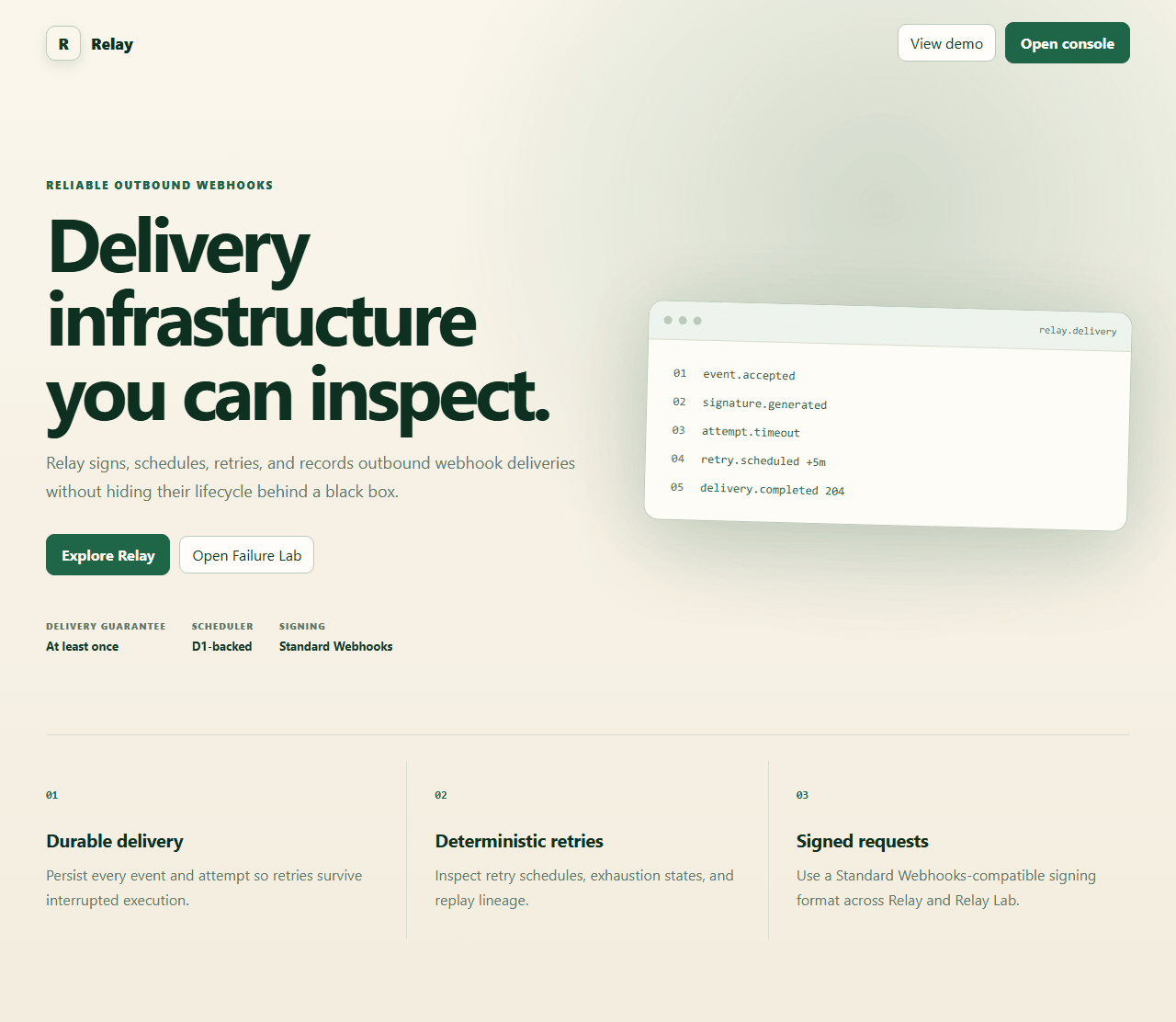
A production webhook delivery platform that turns retries, receiver failures, signatures, and recovery into a durable lifecycle operators can inspect instead of infer.
01
Sending one HTTP request is easy. Preserving delivery intent through timeouts, rate limits, process interruption, secret rotation, and incident review is a distributed-systems problem.
Relay was designed so an accepted event always has durable work behind it, retries remain bounded and explainable, receivers can deduplicate requests, and operators have enough evidence to understand every outcome.
02
D1 is the durable source of truth. The Queue transports ready delivery identifiers, while a scheduled Worker republishes due outbox work, recovers expired leases, and applies bounded retention.
03
04
A stable webhook ID gives receivers an idempotency key while lease recovery accepts that duplicate network delivery can occur.
Event acceptance, endpoint fanout, and publication intent commit together so accepted work cannot disappear between the database and queue.
D1 owns due time, retry policy, and recovery. Queue messages remain compact wake-ups for work that is ready now.
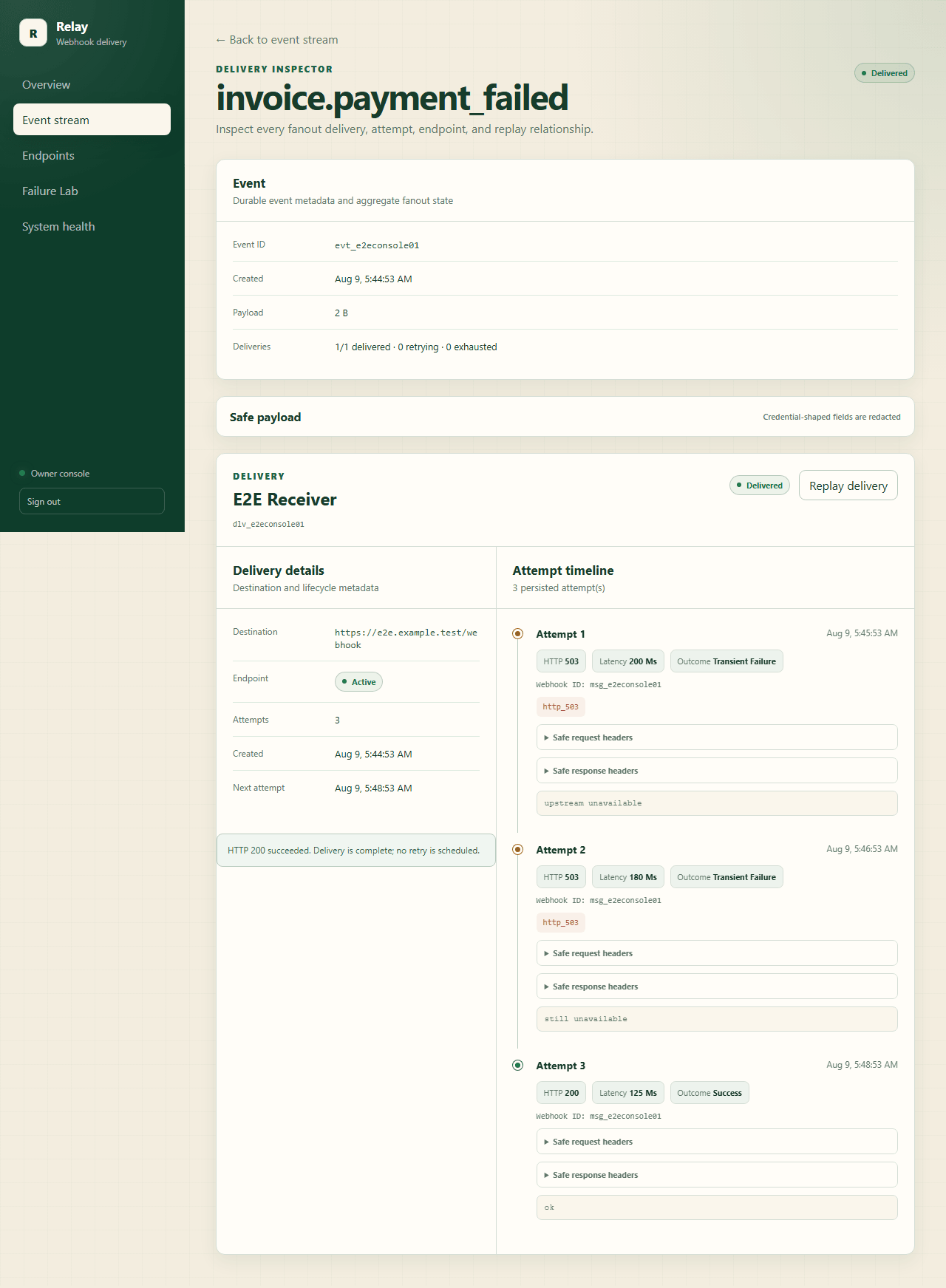
Every delivery attempt records bounded, redacted evidence, making retries, replay lineage, and terminal outcomes inspectable from the console.
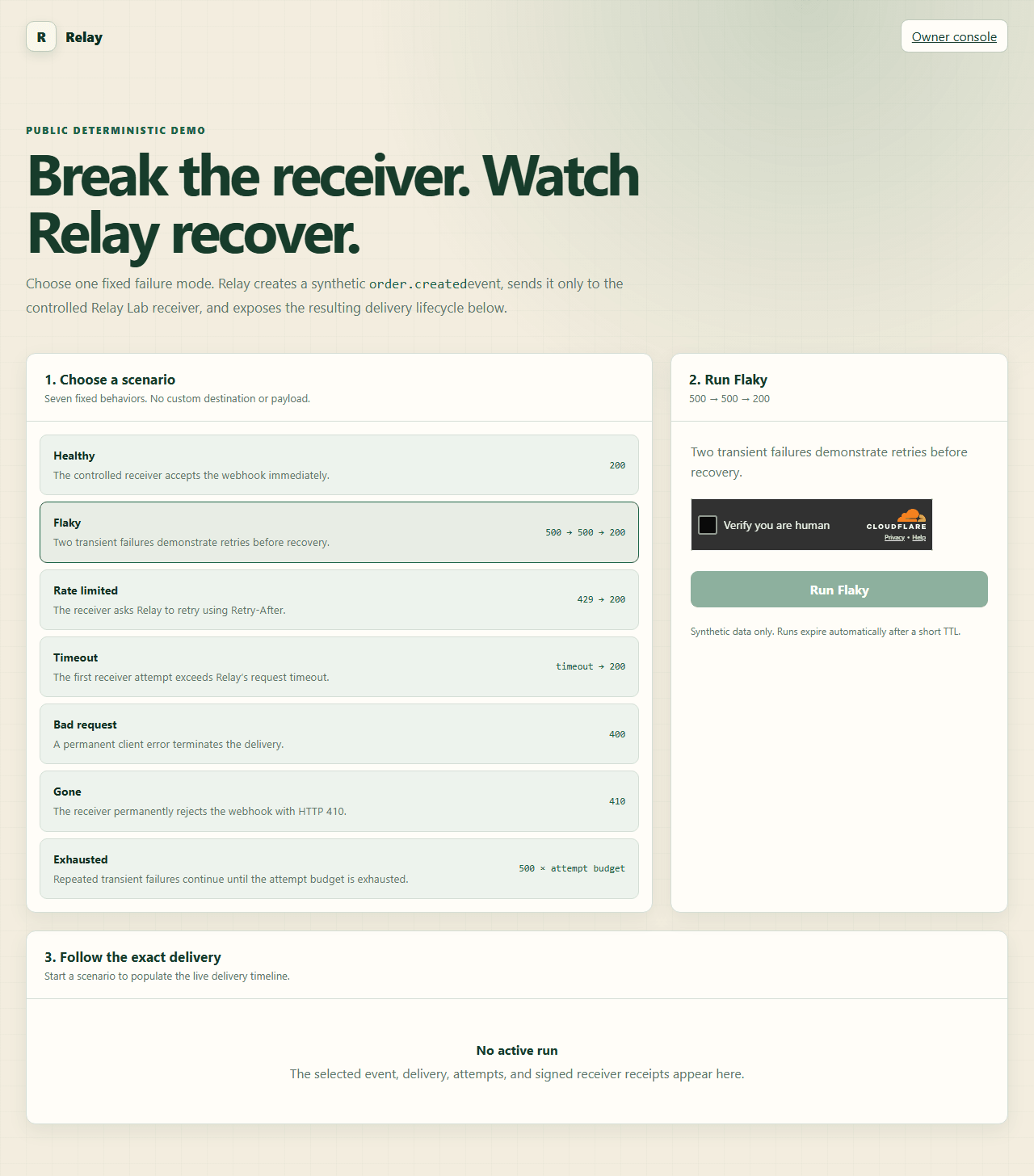
Failure Lab exposes seven fixed receiver behaviors behind Turnstile and quotas without accepting arbitrary URLs or payloads.
Two Workers, D1, Queues, Cron, Turnstile, and a Service Binding demonstrate the system without paid infrastructure or hidden trial dependencies.
05 / Public demonstration
06
The release combines application tests, database-backed Worker tests, browser journeys, responsive and accessibility coverage, publishing safety, cost guardrails, and a controlled production retry run.
In production, the flaky receiver returned HTTP 500 twice and HTTP 200 on the third attempt. Relay preserved one webhook identity, generated fresh signatures, and recorded each receiver receipt.
07
Relay demonstrates production reasoning beyond CRUD: transactional boundaries, concurrency control, cryptographic handling, failure classification, cost-aware operations, and evidence-backed delivery.