Credentials authentication and JWT sessions
Auth.js Credentials authentication uses encrypted JWT sessions because database-session support is not used for this provider strategy. It is a fit for this architecture, not a universal default.
Full-stack product · Career management
A production-deployed application for organizing job opportunities, application progress, deadlines, and targeted resume versions.
01
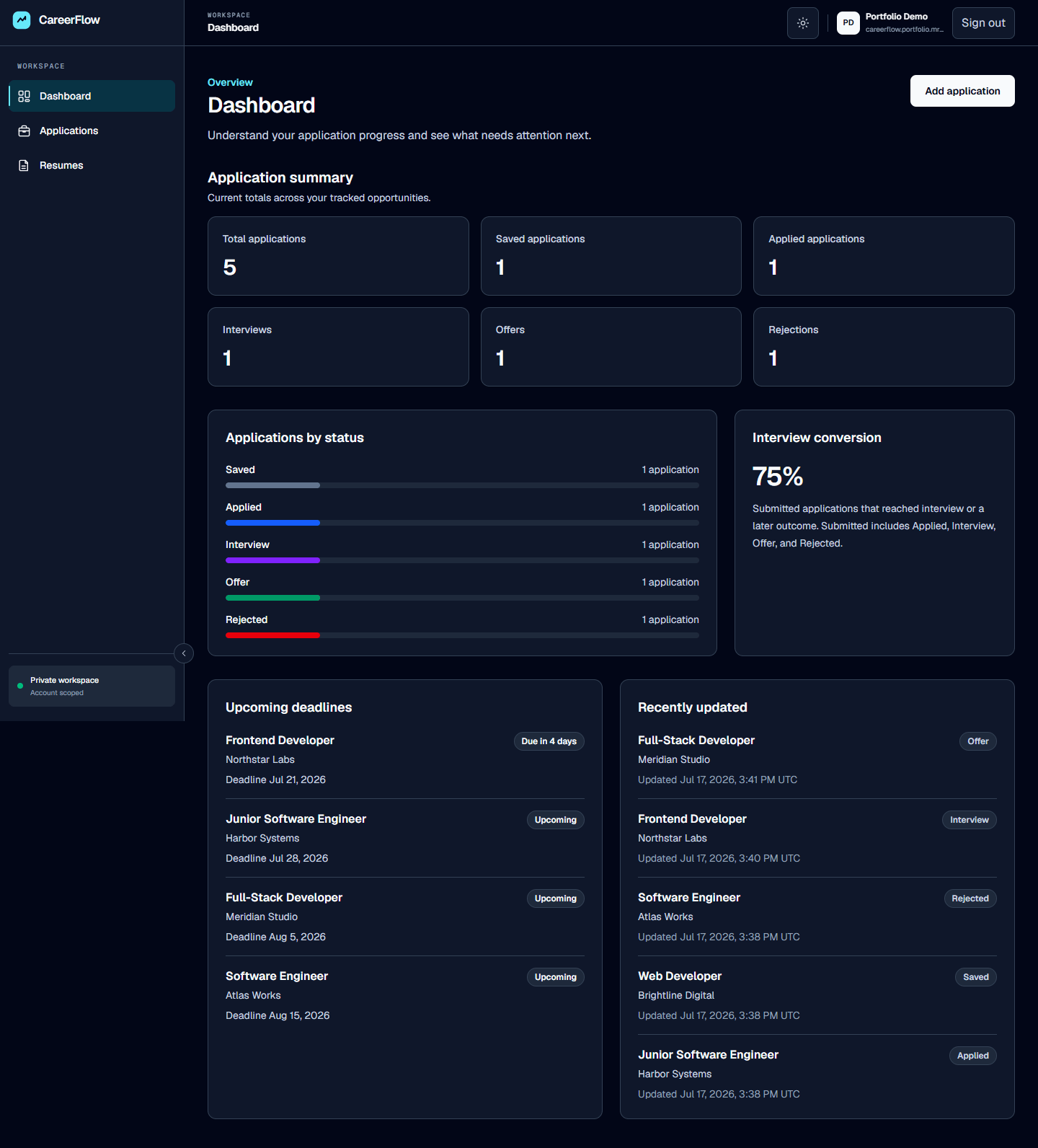
A serious job search quickly produces more information than a simple list can handle: opportunities at different stages, follow-up dates, salary ranges, deadlines, and multiple resume versions.
That information often fragments across notes, bookmarks, spreadsheets, calendars, and files. CareerFlow was designed to bring the workflow into one focused, account-scoped system without turning it into a noisy productivity suite.
02
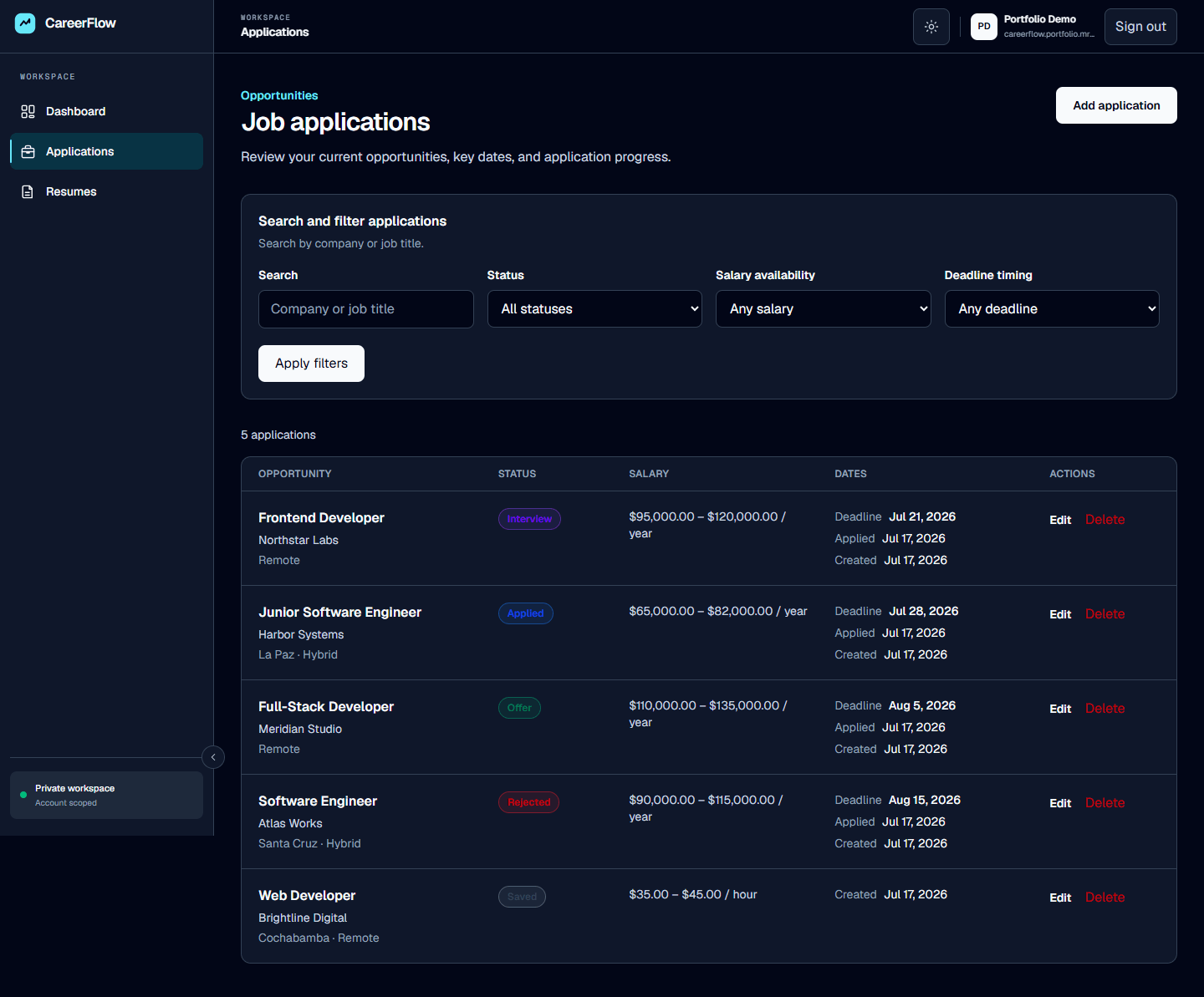
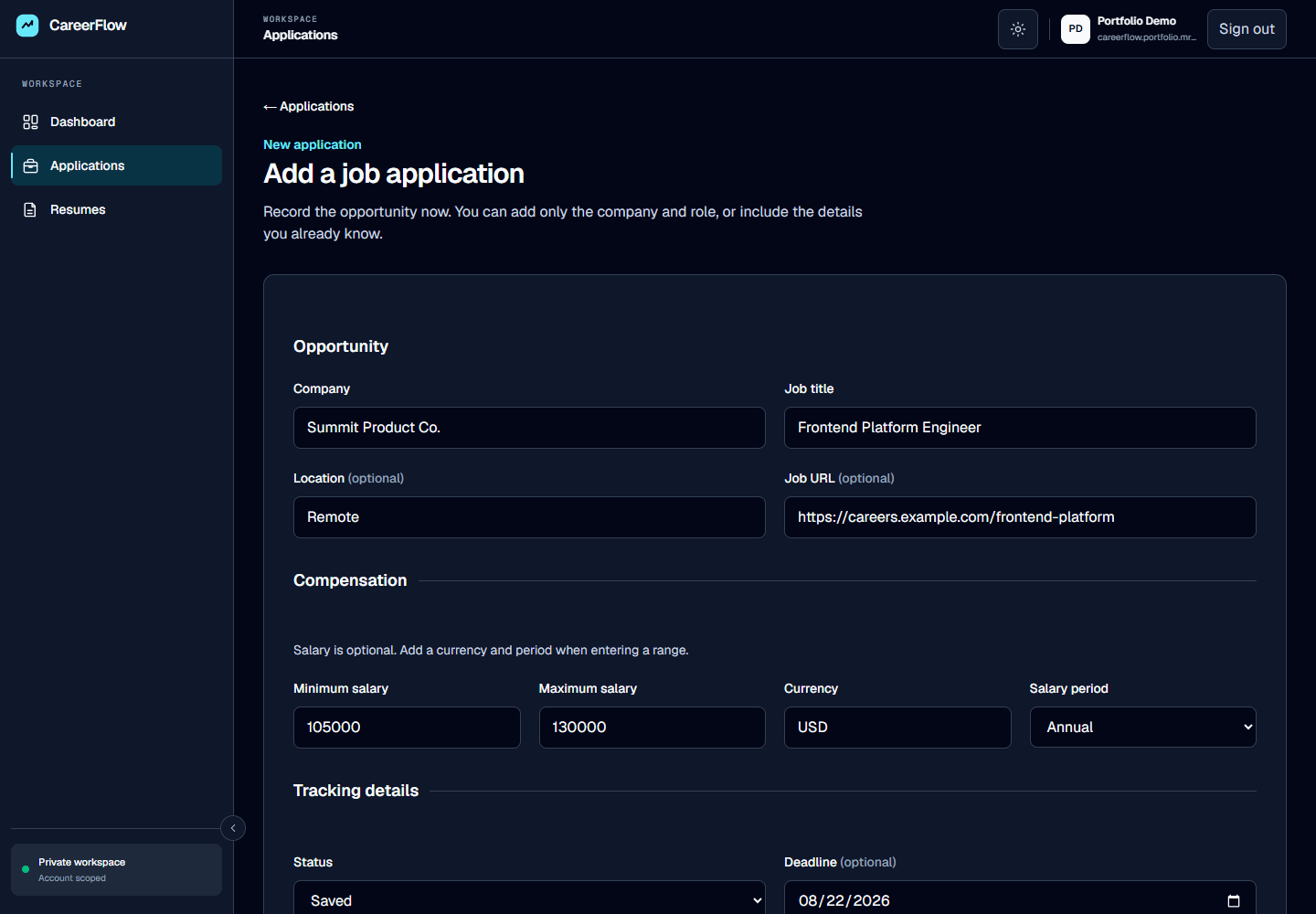
The central workflow follows an opportunity from first capture to final outcome while keeping the resume used for that application connected to the record.
03
04
CareerFlow is one Next.js application: React interfaces and Server Components call server-owned application logic, Auth.js establishes identity, and Prisma persists owned data in PostgreSQL on Neon. Vercel hosts the application and health endpoint.
05
Auth.js Credentials authentication uses encrypted JWT sessions because database-session support is not used for this provider strategy. It is a fit for this architecture, not a universal default.
Every application and resume operation is scoped to the authenticated user on the server. Knowing another record’s URL or identifier is never authorization to read or change it.
Salary ranges are stored in ISO 4217 minor units, then formatted with the runtime’s internationalization support to avoid floating-point currency errors.
Version 1.0 uses UTC consistently instead of introducing partially implemented user-time-zone behavior.
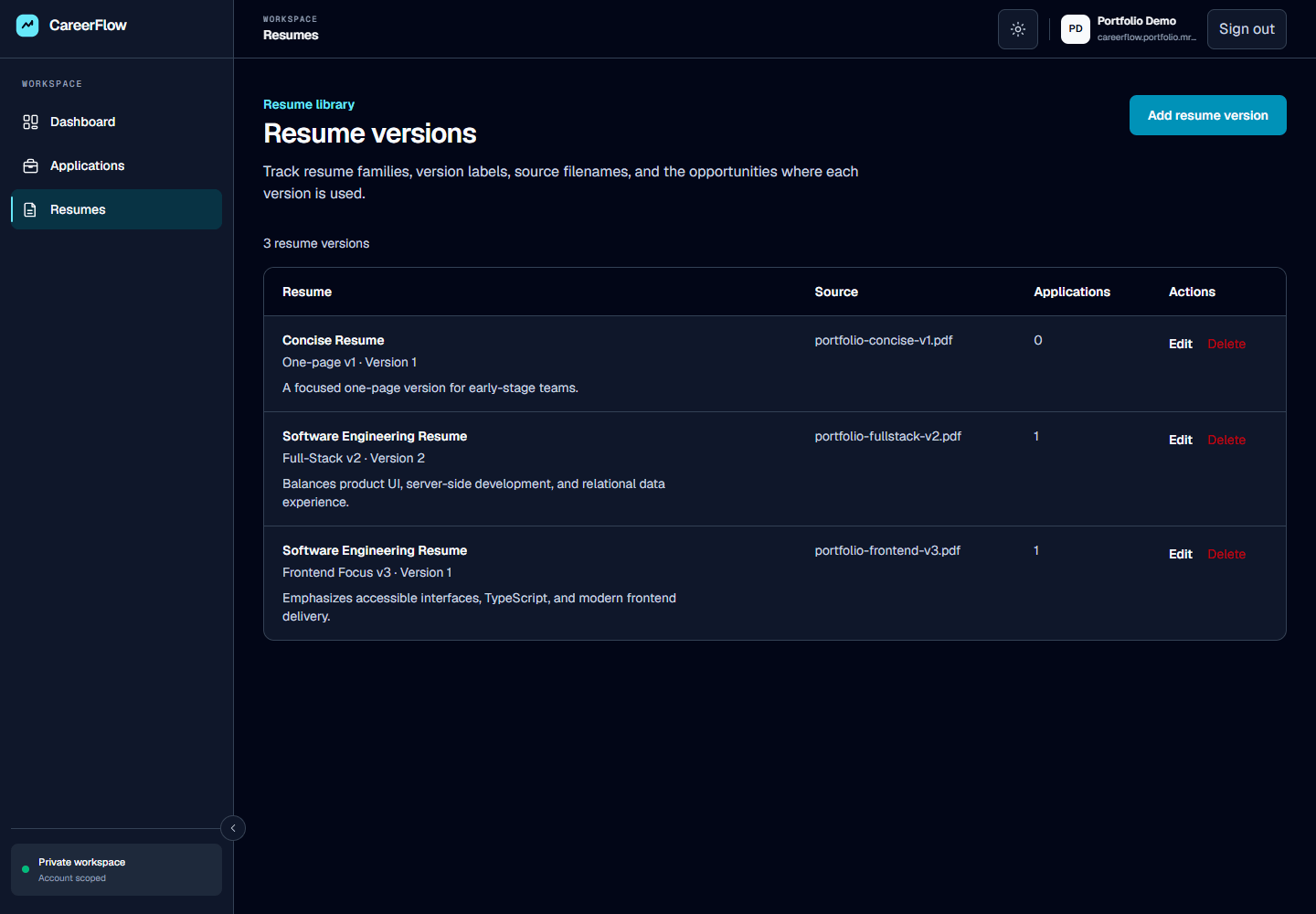
A shared resume family can contain independently labeled versions, and each application can reference the version used for that opportunity.
Once deployment history was established, existing database migrations were retained rather than rewritten for presentation convenience.
06
The release-readiness suite completed with 179 passing tests when the PostgreSQL-backed test environment was enabled. The default suite reports 150 passing tests and gates 29 database tests until that disposable environment is available.
Validation also covered the production build, migration application, authentication and protected routes, ownership isolation, desktop and mobile browser behavior, and an accessibility review. These are release-baseline results, not a claim that the software is formally certified or bug-free.
07
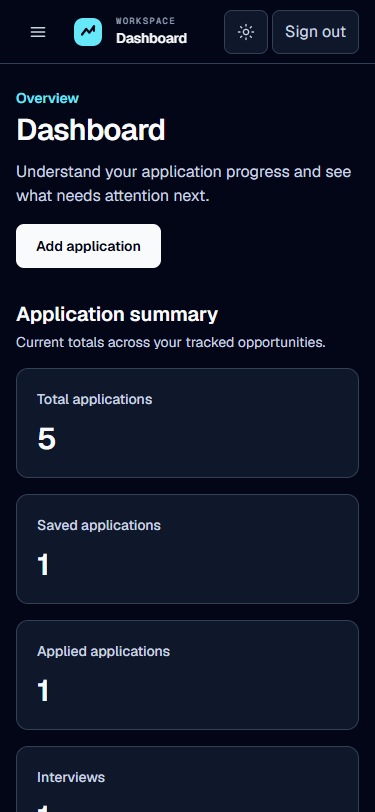
Accessibility was treated as product behavior: semantic controls, keyboard navigation, visible focus, managed dialogs, connected validation errors, an accessible mobile drawer, screen-reader labels, and reduced-motion awareness.
The work was reviewed across common keyboard and responsive paths; it is not presented as formal WCAG certification.
08
The portfolio release runs within a zero-cost operating constraint on Vercel Hobby and Neon Free. Production environment variables are encrypted by the hosting platform, and a minimal health endpoint checks database readiness without disclosing connection data.
09 / Product preview
The silent preview shows the dashboard, opportunity tracking, application editor, and resume organization. The adjacent text provides the same overview without requiring playback.
10
CareerFlow demonstrates the complete product lifecycle: scoped product design, authentication, relational data, responsive and accessible interfaces, automated testing, deployment, and honest release documentation.